Natasha Kingsley and Rob’s relationship and breakup
The Sun is Also a StarNatasha Kingsley and Rob’s relationship is a formative but brief romance whose betrayal shapes Natasha’s skepticism about love. She enjoys the rituals of being a couple, and she genuinely likes Rob; after he cheats on her with Kelly, however, the hurt gives way surprisingly quickly to emotional distance. In retrospect, she treats the relationship as evidence that love can decay, and wonders whether feelings that end so readily were ever trustworthy.
Beginnings and the Pleasures of Couplehood
Natasha first notices Rob in AP Physics, where she is an overachiever and he asks her for help with isotopes and half-lives. After passing the following week’s quiz, he asks her to the movies. Couplehood is new to Natasha, but she likes its recognizable routines: meeting Rob at his locker between classes, having weekend plans, and being thought of as part of a couple. She and Rob also double-date with Bev and Derrick, making the relationship part of her familiar social life.
Natasha does not dismiss the affection as false simply because the relationship ends badly. Looking back, she admits that she liked Rob, liked looking at him, and liked kissing him. Those ordinary pleasures matter to her account: she had not been swept into a grand or consuming romance, but she had felt real enjoyment and attachment. The relationship’s significance lies partly in the gap between that genuine liking and the ease with which, later, she finds herself able to live without him.
Betrayal and the Encounter at Second Coming Records
Rob cheats on Natasha with Kelly. Natasha recalls feeling hurt and betrayed, as well as ashamed, as though his infidelity were somehow her fault. What she cannot resolve is why Rob pretended while the relationship continued rather than ending it and pursuing Kelly openly. That unanswered question makes the betrayal more than a change of partners: it leaves Natasha questioning the honesty of the relationship she thought they shared.
By the time Natasha sees Rob again, he is her ex-boyfriend. At Second Coming Records, she spots him making out with Kelly in the pop-diva section, beside a Madonna poster. She recognizes Rob by his profile before she can make out the couple’s faces clearly. Kelly’s hand slips a record between their bodies and into her bulky jacket, so the sight reunites Natasha not only with the person who betrayed her but with the girl involved in the affair, now stealing from the store. When a stranger asks whether she knows them, Natasha explains the relationship in a flustered aside: Kelly is her ex-boyfriend’s girlfriend, and Rob cheated on her with Kelly. She later recognizes that she has disclosed something personal to someone she has only just met, partly because seeing Rob has unsettled her.
Rob notices Natasha watching. He gives her his familiar half-smile and waves; she nearly responds with an obscene gesture and wonders how she could have dated him for eight months and four days, or let him hold her hands and kiss her. The precise duration sharpens the contrast between the time invested and the contempt of the moment. Outside, Natasha sees Rob and Kelly again. Kelly is crying while Rob appears to be explaining himself, and Natasha suspects he will persuade Kelly, as he is persuasive and Kelly wants to believe him. The scene echoes Natasha’s own experience without claiming to settle what happens between them afterward.
What Remains After the Breakup
Natasha says she did not cry when she discovered Rob’s cheating the previous winter. Her lack of tears does not mean the betrayal was painless: she remembers the hurt and shame plainly. Instead, she emphasizes how little time it took her to get over him. The speed troubles her more than the end itself. People devote poems, songs, and novels to love, she reflects, yet her own feelings seem to have disappeared almost as quickly as they began. She wonders how anyone can trust an emotion that can end so suddenly.
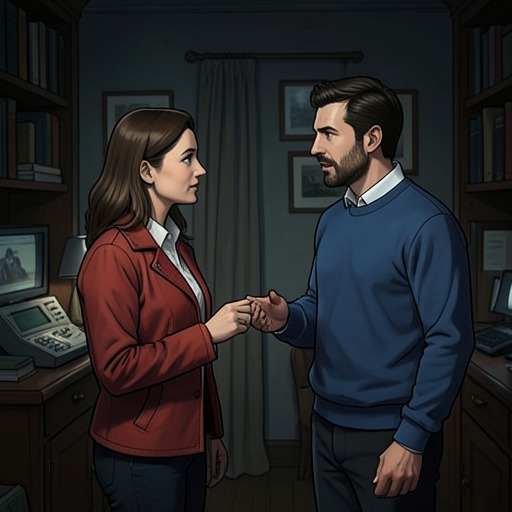
That doubt also appears in her anger at Rob after the breakup. He has recently told her they should be able to remain friends despite what happened. Natasha resents the implication that the affair can be set aside under the vague label of everything that has occurred. Her response is part of a broader period of anger, but Rob’s request brings the unresolved betrayal into the present: he seems to expect friendship while she is still reckoning with his choice and with the questions it left behind.
The Half-Life of Love
Natasha organizes her thoughts about the relationship through the language of physics. A half-life is the time it takes for a substance to lose half its initial value; in her own formulation, love’s half-life is the time lovers take to feel half of what they once felt. She extends the scientific comparison to unstable atoms and imagines love as having an infinitesimally small half-life, decaying until it is gone. The metaphor gives measurable form to her unease: if affection can diminish, she fears, its disappearance may make the past feel unreal too.
Her skepticism is not merely an abstract theory. Natasha dislikes temporary, unprovable things, and she considers romantic love both temporary and unprovable. She confesses to herself that she is unsure she is capable of love, even temporarily. With Rob, she did not feel swept away, consumed, or as though she needed him to live. She liked him and liked being close to him, but always knew she could live without him. The relationship therefore becomes her example for distinguishing liking someone from the absolute, consuming love celebrated in songs.
Natasha’s knowledge of the chemistry of attraction reinforces this interpretation. She knows the stages and associated chemicals, and she says that understanding them helped her get over Rob’s betrayal. Her conclusion is that love is chemicals and coincidence. Yet the story later places that certainty under pressure when Natasha finds herself asking why Daniel feels like something more. Rob’s relationship with her thus remains important beyond its own ending: it supplies the experience and explanatory framework against which she measures a new possibility, without erasing either the reality of her earlier affection or the damage of Rob’s infidelity.